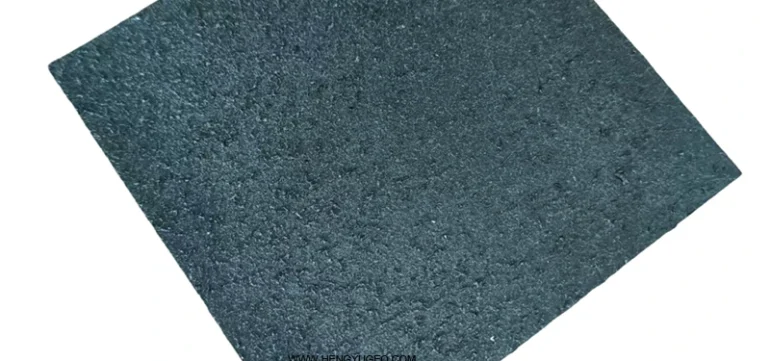
Rough surface geomembrane
Product Introduction
The rough surface geomembrane is a high-density polyethylene (HDPE) geomembrane manufactured using an advanced blown film process. Through technical innovations in production equipment, a textured surface is created via nitrogen texturing, water quenching, or spray texturing techniques.
As a new type of impermeable material, the rough surface geomembrane is available in both single-sided and double-sided textured variants. The textured surface provides an increased friction coefficient and anti-slip properties, making it particularly suitable for vertical impermeability applications on steep slopes and enhancing project stability.
The textured surface improves the frictional performance of the geomembrane. Compared to smooth geomembranes of the same specification, the rough surface creates micro-gaps between the membrane and the subgrade during installation. This structural characteristic enhances the membrane’s resistance to bearing deformation. Consequently, it is commonly used in projects where slopes require a high friction coefficient.
The material exhibits excellent temperature adaptability, extensibility, and weather resistance. It also demonstrates good aging resistance, chemical corrosion resistance, and environmental stress crack resistance.
Primary Applications
Landfill sites
Wastewater and liquid treatment facilities
Water conservancy and environmental protection projects
Tailings pond engineering
Waste residue treatment facilities
(Used as anti-leakage materials in these applications)
Product Specifications
Thickness: 1.0mm – 3.0mm
Width: 1m – 8m
Roll Length: 50m – 100m (Custom sizes available upon request)
Please specify the product and specifications you require.
echnical indicators
Environmental protection with brown high-density polyethylene geomembrane <GB/T 17643-2011 GH-2T1. GH-2T2 type technical indicators>.
| Thicknesses mm | 0.75 | 1.00 | 1.25 | 1.50 | 2.00 | 2.50 | 3.00 |
| Densities g/cm³ | ≥ 0.940 | ||||||
| Roughness height | ≥0.25 | ||||||
| Tensile yield strength (longitudinal and transverse) N/mm | ≥11 | ≥15 | ≥18 | ≥22 | ≥29 | ≥37 | ≥44 |
| Tensile breaking strength (longitudinal and transverse) N/mm | ≥8 | ≥10 | ≥13 | ≥16 | ≥21 | ≥26 | ≥32 |
| Yield elongation (longitudinal and transverse) % | ≥12 | ||||||
| Elongation at break (longitudinal and transverse) % | ≥100 | ||||||
| Right angle tearing load (longitudinal and transverse) N | ≥93 | ≥125 | ≥160 | ≥190 | ≥250 | ≥315 | ≥375 |
| puncture strength N | ≥ 200 | ≥ 270 | ≥335 | ≥400 | ≥ 535 | ≥670 | ≥800 |
| Stress cracking under tensile load | ≥300 | ||||||
| Carbon black content % | 2.0-3.0 | ||||||
| Carbon Black Dispersibility | No more than 1 out of 10 data at level 3, not allowed at levels 4 and 5 | ||||||
| Atmospheric pressure oxidation induction time (OIT)min | Atmospheric pressure oxidation induction time ≥ 100 | ||||||
| High pressure oxidation induction time ≥ 400 | |||||||
| 85°C heat aging % | ≥55 | ||||||
| anti-ultraviolet | ≥ 50 | ||||||